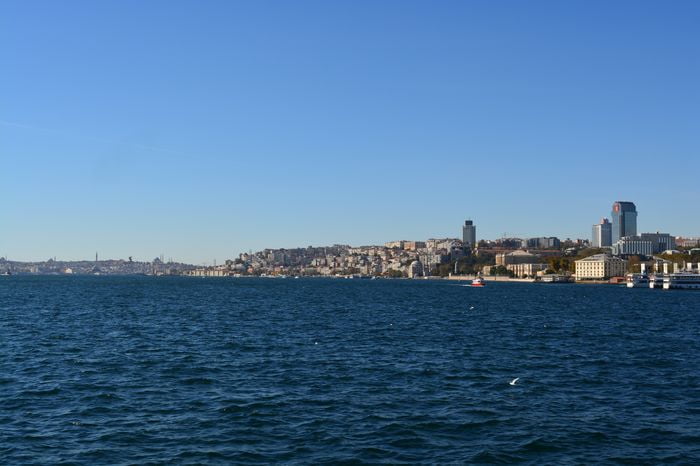
One final and very strong proof of the position of the Hebdomon comes from the visit of Pope Constantine to Constantinople in the year 708. The Pope travelled to the imperial capital to resolve important disputes between the Eastern and Western Churches. His journey and reception are described in detail by contemporary sources, and they clearly show that the Hebdomon was located on the shore of the Sea of Marmora.
Pope Constantine came entirely by sea until he reached the Hebdomon. This is an important detail. He did not approach the city by land, nor did he disembark at the city walls. Instead, he landed at the Hebdomon, which lay outside Constantinople but close enough to allow a ceremonial entry into the capital Customized Sofia Tours.
A Ceremonial Landing at the Hebdomon
After the Pope and his attendants disembarked, they were received with great honour. The welcome was not informal or improvised. The Emperor Tiberius, the son of Justinian II, personally went out to meet the Pope. He was accompanied by high-ranking officials, clergy, and a large crowd of people.
The sources describe the scene as festive and joyful. The people celebrated the day as a public holiday, showing how important the Pope’s visit was considered. The Pope and his chief companions were then provided with horses from the Imperial stables, richly equipped with golden saddles and bridles. They also received ceremonial garments and insignia suitable for an official procession.
Mounted in this splendid manner, the Pope and his entourage rode from the Hebdomon into Constantinople, entering the city in full ceremonial state. Such a procession could only have taken place if the Hebdomon was located on the coast, where ships could safely land and where imperial officials could assemble to escort distinguished visitors.
Why This Account Is So Important
This account leaves no room for confusion. If the Hebdomon had not been on the Sea of Marmora, Pope Constantine could not have reached it directly by ship. Nor would it have been practical for the emperor to receive him there before escorting him into the city The Hebdomon and Its Position by the Sea.
The event also confirms that the Hebdomon functioned as a formal point of arrival for important visitors. It was not a small or insignificant place, but a well-known and carefully prepared suburb, equipped to handle ceremonial landings and public processions.
Key Facts About the Hebdomon
From this and earlier evidence, the main features of the Hebdomon can now be clearly stated:
The Hebdomon was located seven miles from Constantinople.
It stood beside the Sea of Marmora.
It possessed a harbour, suitable for ships arriving from the south.
It also included a large open plain, known as the Campus of the Hebdomon, which was used for military and ceremonial purposes.
Final Conclusion
All the historical evidence points in the same direction. The Hebdomon was a coastal suburb, west of Constantinople, located at the seventh milestone along the Egnatian Road. Its harbour, open plain, and ceremonial importance make its identification certain. The visit of Pope Constantine provides a clear and vivid confirmation of this long-established historical fact.